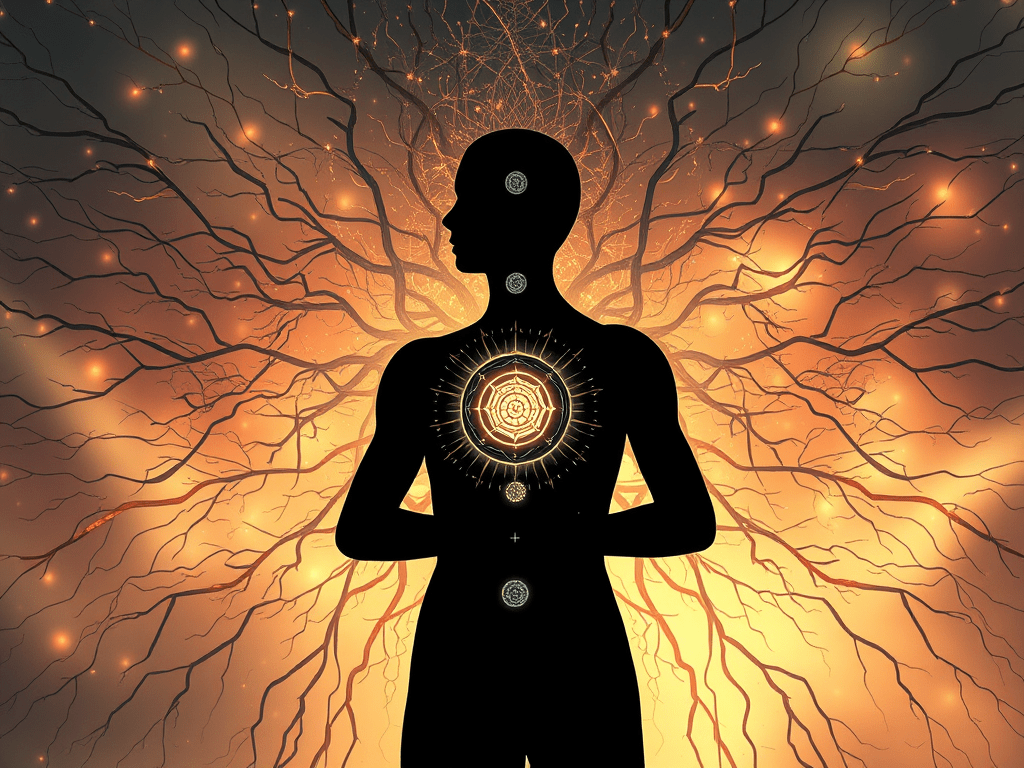
The human body is cellular, not modular. Our consciousness and our memories are diffused throughout the body, rather than being localized within the physical brain. What we think of as the deep subconscious extends into the central nervous system, where it is concentrated in the major chakras. As well as resonating at different frequencies they each represent a different ‘facet’ of the personality. Each interprets reality in a different way. Each corresponds to a different frequency vibration of awareness. When we sleep, the focal point of our consciousness sinks from the brain (outer awareness) into the body (inner awareness) and goes on a sort of journey through the chakras, where we sort out our memories of the day’s events and attempt to smooth over any imbalances that have occurred. The fewer imbalances there are the easier the journey and the better the quality of our sleep. The landscape of the world we come across in our dreams is really the psyche’s visual interpretation of the energy patterns present within the chakras. One of the purposes of sleep is to sort out our memories of the day’s events and transfer them from short to long term memory. Many of these memories end up being stored in the major chakras as long-term sense impressions, what is sometimes known as ‘body memory,’ or more specifically ‘procedural memory’. This when you absorb a particular skill set, such as playing a musical instrument or a sport or anything else that’s done in a semi-conscious way. The ‘information’ of the ability is stored in the unconscious, in the chakras themselves. It becomes deeply imprinted in the energy system through sheer repetition. Practicing over and over creates patterns of movement that flow. However, systemic reviews of research into body memory have concluded that there is neither sufficient evidence to confirm or refute the concept.
This kind of nervous system and muscle memory is capable of surviving massive physical damage to the brain. A person who has suffered brain injuries resulting in memory loss has not truly lost their long-term memories; rather, that person has lost the capacity to access the long-term memories stored within their energy system. Conversely, there are people who have suffered severe brain injuries who managed to regain their sense of self again, once their brain rewired itself and re-accessed the memories stored deep within the energy system.
Long term memories, then, do not exist solely as physical traces in the brain, but exist as a kind of a wave function, spread diffusely through the body down to the cellular level. These memories can be accessed more or less instantaneously, as recall happens through a resonant field and not just through electrochemical processes. When an EEG or a CAT scan shows areas of the brain ‘lighting up’ as specific memories are recalled, this is the physical brain responding emotionally to the memories being accessed.
If each individual cell contains the complete DNA instructions for building and maintaining the entire physical body, then it could be that the electromagnetic field surrounding the cell also contains a microcosm of the persons personality and life memories. This kind of holographic memory could be accessed virtually instantaneously, as the process of recall would not be dependent on any electrochemical process but would exist in a personal resonant field which surrounds and permeates the physical body. It is a two-way street: the patterns of the resonant field also guide and determine the activity of the physical body. Memory patterns can persist for many decades, even in a biological system in which individual cells of the brain and the nervous system are constantly being replaced. If memories exist as non-localized wave resonances it would explain how the patterns could be maintained even as the physical body changes and some cells die off.
In his book ‘The Science Delusion’ Rupert Sheldrake contends that the mind can be likened to a TV set which is tuned into various frequencies to receive TV shows. If you were to take apart a TV and examine its circuit boards and wiring, you wouldn’t be able to determine what was on TV last night. Television shows do not remain as material traces in its circuitry; they spread out as a wave function which the TV set tunes into by matching frequencies.
These ‘morphic fields’ help shape our psyche and how we view the world. Dreams, ideas, visions, and inspiration are all received through patterns of consciousness which perpetuate through time and resonate most closely with those who are on similar wavelengths. Our long-term recollection depends on what Sheldrake terms ‘morphic resonance,’ in which memories resonate from our own pasts into the present. These patterns tend to resonate with that which is the most similar to themselves; an individual’s psyche will share the most similarity with its own self in the past. It shares the same frequency vibration.
Collective memory across a group operates on a similar principle, which would explain how sometimes people who are separated by great distances can generate the same thought-forms and come up with strikingly similar ideas. There is still some controversy as to whether it was Isaac Newton or Gottfried Liebnitz who first came up with Calculus. Could they have both tapped into similar mental frequencies? It could be the foundation for the Jungian theory of the ‘mass unconscious’, a kind of universal wellspring of inspiration which anyone can ‘tune into’ if we can tap into the right psychological frequencies.
A butterfly chrysalis retains memory of its old form even after transformation into adult butterfly. It remembers its old life as a caterpillar even through it must dissolve completely into an undifferentiated soup if it is to become the butterfly. This shows us that memory must be diffused non locally throughout the cellular system, rather than being concentrated in a single area. The preferences they showed in their previous life show up again in their new form. Tests were done on caterpillars where they were taught to associate a certain odour with a small electric shock. They quickly learned to avoid any areas that had that odour to avoid being shocked. When they became butterflies the association remained: they wouldn’t go near any plants that had that same odour. They retained the memory even after their previous bodies were broken down completely.
Memory is a non-localized phenomenon which doesn’t even require an intact brain. A cell contains enough DNA information to reconstruct the entire physical body; its chakra pattern should potentially contain all the information that makes up the personality, including all the long-term memories. So as well as being focal points of energy flow, chakras are also focal points of consciousness. They are the root of the body’s etheric field.
 Cosmic-multiplicity
Leave a comment